
Jones County Arrest Records
Jones County arrest records begin on the law enforcement side. The sheriff, a police agency, or another officer may make an arrest after a warrant, after a traffic or criminal stop, or after a new offense investigation. Booking and custody details are tied to the Jones County Detention Center and the Sheriff's Office, not to a court judgment. The court record begins to answer a different question: what charge did the State file, what court division is handling it, and what is the current status of that charge.
The local court charge record is maintained through the North Carolina General Court of Justice, with Jones County cases handled in District Court or Superior Court depending on the offense. Misdemeanors and many infractions are District Court matters. Felonies often start with early District Court steps and move to Superior Court for indictment, plea, trial, or sentencing. For booking and custody detail, use the Jones County inmate records route. For the full case file, disposition, and sentence, use Jones County criminal court records.
The North Carolina warrant-for-arrest statute is one source for the arrest-to-charge path. It describes a warrant for arrest as a statement of the crime and an order to arrest and hold the accused to answer the charge.
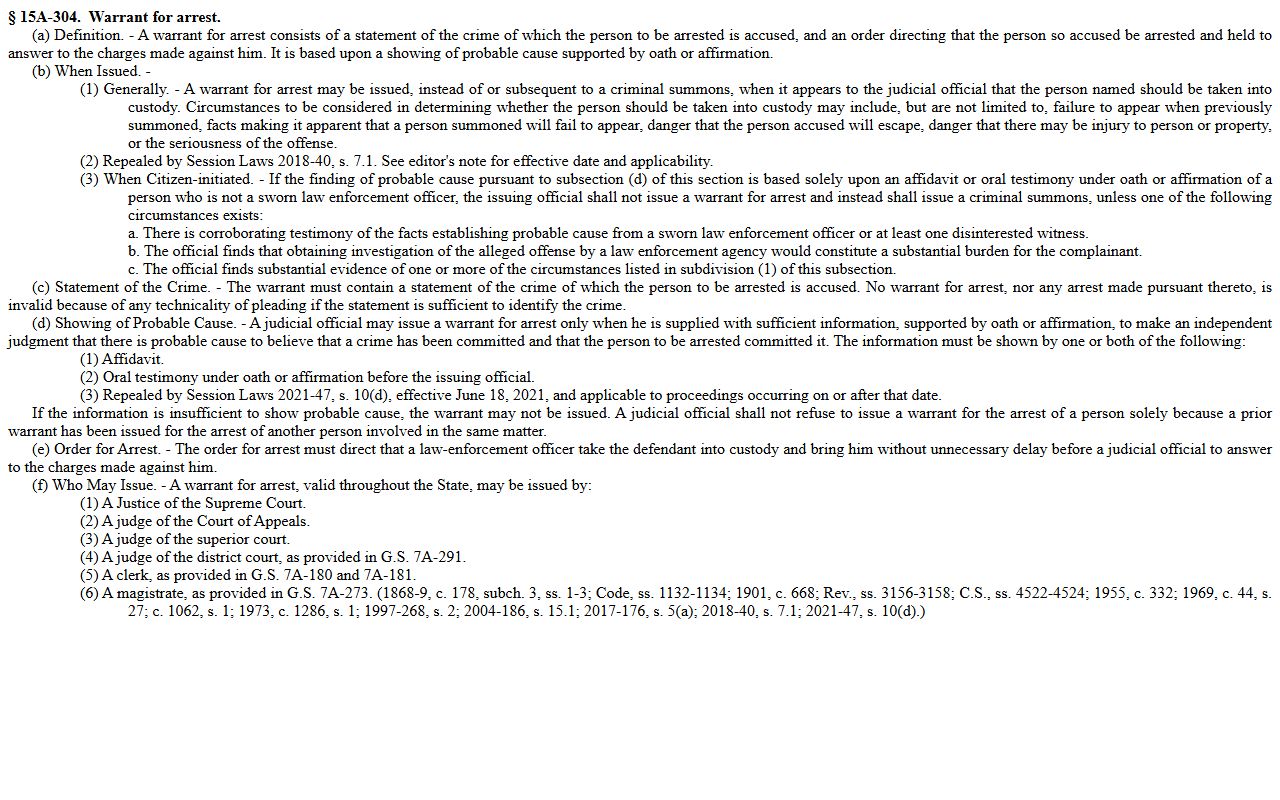
That statute is important in Jones County because a warrant can create the custody event and point to the charge that later appears in the court case.
Find Jones County Charges
Jones County court charges are searched through official court channels first. The North Carolina eCourts Portal is the statewide online route for Smart Search, hearing search, payments, and judgment search in eCourts counties. Portal materials identify party name, case number, attorney, citation, county, and related filters as search concepts. If the online result is incomplete, the official fallback is the public terminal or paper file at the Clerk of Superior Court.
- Start with Smart Search in the North Carolina eCourts Portal and narrow the location to Jones County when the option is available.
- Search by defendant name, case number, or citation number, then open the criminal or infraction case result.
- Read each listed charge, case event, hearing, bond entry, and disposition field instead of relying on the arrest label alone.
- If the charge status is unclear, call or visit the Jones County Clerk of Superior Court for the official case file.
- For custody, release, or booking status, contact the Jones County Detention Center because no official public Jones online jail roster was located.
Public terminals are a key fallback. The Judicial Branch says criminal case information can be accessed at a public self-service terminal in a clerk's office and can be searched by defendant name, case number, or victim and witness name. For Jones County, the local clerk is at the Jones County Courthouse, 101 Market St, Trenton, NC 28585, phone (252) 448-6220.
Jones County Charging Papers
After an arrest, the charge record is built from a legal paper that accuses a person of an offense. In North Carolina, that paper may be a criminal summons, a warrant for arrest, an indictment, or another charge document used in the case. A magistrate may issue a warrant or criminal summons when probable cause is found. The District Attorney then prosecutes the State's charges in the proper trial division.
| Document | Who Uses It | Jones County Record Meaning |
|---|---|---|
| Criminal summons | Magistrate or judicial official | Starts a criminal charge without arrest when service is used instead of custody. |
| Warrant for arrest | Magistrate or court official | States the crime and directs law enforcement to arrest and bring the accused before the court. |
| Indictment | Grand jury | Common felony charging paper for Superior Court prosecution after the case develops. |
| Information or prosecutor filing | District Attorney | Formal prosecution document where allowed by North Carolina procedure. |
The initial appearance statute explains what follows arrest. An officer must take the arrested person before a magistrate without unnecessary delay, and the magistrate informs the person of the charges, communication rights, and release conditions.
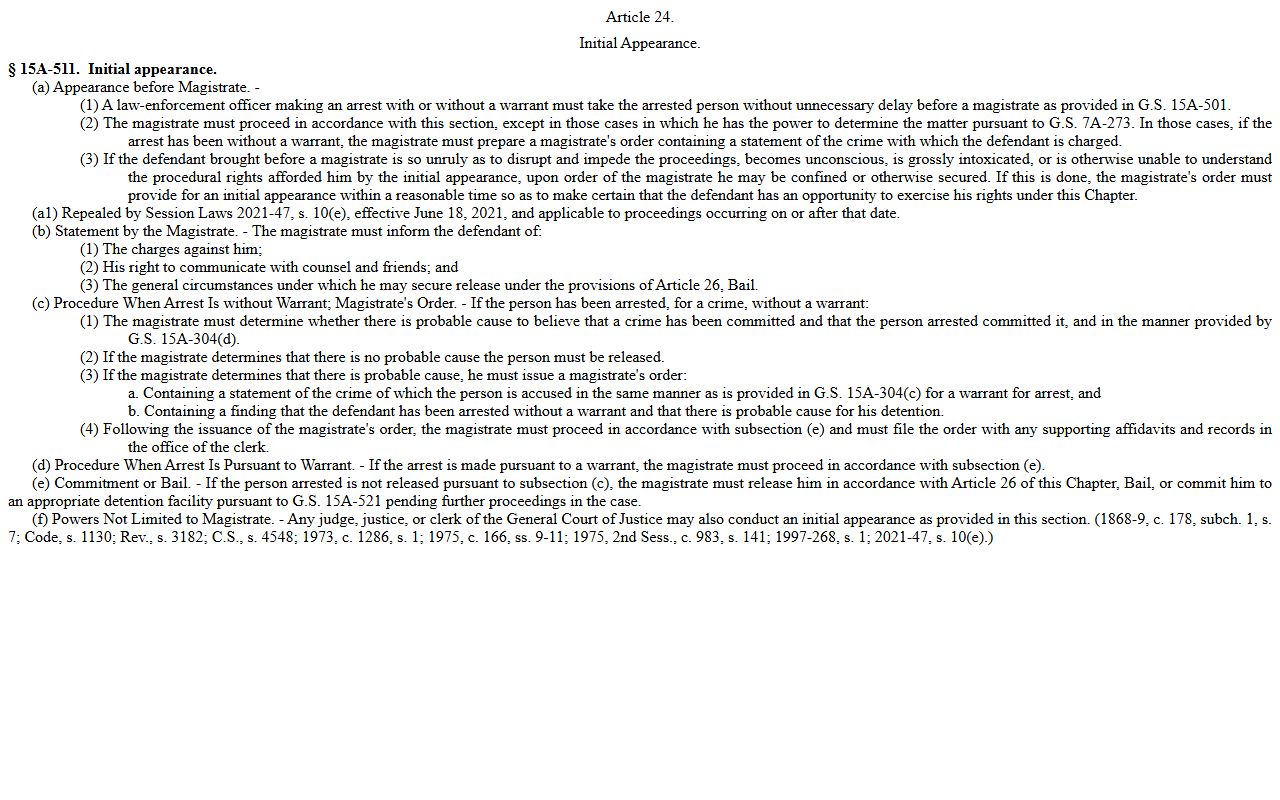
This first appearance step is why a court charge record may show bond or release conditions soon after the arrest record appears.
Jones County Charge Status
One arrest can produce one charge, several charges, or no filed case if prosecutors do not proceed. A charge can also change after the first filing. The court record may show a reduction, amendment, dismissal, plea, trial result, or sentence. The status field should be read charge by charge, because a person may be convicted on one count while another count is dismissed.
| Status | What It Means | How to Verify |
|---|---|---|
| Pending | The charge is still active and has not reached final disposition. | Check Portal hearings and confirm with the clerk. |
| Amended or reduced | The filed charge changed, often by prosecutor action or plea negotiation. | Read the docket entries and final judgment. |
| Dismissed | The charge ended without a conviction on that count. | Confirm whether any other charges remain. |
| Convicted | The defendant was found guilty or entered a guilty plea on that charge. | Review judgment, sentence, fines, costs, and probation entries. |
| Sealed or restricted | Public access may be blocked by statute or court order. | Ask the Clerk of Superior Court about access rules. |
Note: Do not treat an arrest, charge, dismissal, and conviction as the same event; each has a distinct record meaning.
Charges and Convictions
A Jones County charge is an accusation filed in court. A conviction is a final result after a guilty plea, guilty verdict, or other judgment that establishes guilt. The distinction matters for employment forms, housing screening, licensing, sentencing, and expunction review. It also matters when reading old records because a search result may still list the original charge even if the final disposition is less serious.
| Record Item | Charge | Conviction |
|---|---|---|
| Stage | Accusation filed after investigation, summons, warrant, or indictment. | Final finding or plea that resolves the charge as guilty. |
| Proof level | Probable cause or formal accusation, depending on the paper. | Guilty plea or proof beyond a reasonable doubt at trial. |
| Record location | Criminal case file, charge list, warrant return, or docket entry. | Judgment, disposition, sentence, probation, fines, and costs. |
| Practical use | Shows what the State alleged at that point. | Shows the outcome that may affect later criminal history. |
Jones County Offense Levels
Jones County charge records use North Carolina offense categories. Infractions are noncriminal violations often seen in traffic matters. Misdemeanors are lower-level criminal offenses and are primarily handled in District Court. Felonies are more serious crimes and generally move through Superior Court for indictment, plea, trial, and sentencing, though early felony steps may occur in District Court.
The District Attorney for Prosecutorial District 5 prosecutes criminal charges for the State, including misdemeanors, felonies, infractions, and traffic offenses that are not waived. The Jones County Judicial Branch contact directory lists District Attorney offices in Duplin and Sampson counties for district contact. Questions about what the State intends to do with a pending charge are not the same as record-copy questions, so the clerk and prosecutor have different roles.
The North Carolina Judicial Branch Recovery Courts page describes court-supervised treatment programs for some high-risk and high-need participants, but no Jones-specific Recovery Court page was located in the official sources reviewed.
That statewide program context may matter only when a pending Jones County charge is routed into an approved treatment court option.
Magistrates and First Appearance
Magistrates are central to the early Jones County arrest process. The official contact directory lists Jones County magistrates at (252) 448-6235. A magistrate may issue a criminal summons or arrest warrant when probable cause exists, and after arrest the magistrate sets initial release conditions. Those conditions may include written promise, unsecured bond, secured bond, custody, or later review by the court.
The Judicial Branch court officials page explains magistrates and other court roles in North Carolina.
For Jones County arrest records, the magistrate step is the link between the custody event and the first court-facing charge entry.
Jones County Access Limits
Public access depends on the type and stage of the record. North Carolina's court-record rule in G.S. 7A-109 makes clerk-maintained files, dockets, and indexes open for public inspection during regular office hours except where access is restricted by law. Chapter 132 also treats returned arrest and search warrants, indictments, criminal summonses, and nontestimonial identification orders as public unless sealed by court order. Unserved warrants and sensitive investigative records are different.
| Restricted Item | Jones County Access Point | Why It May Be Limited |
|---|---|---|
| Juvenile charges | Clerk or court order process | G.S. 7B-3000 withholds juvenile records from public inspection except as allowed. |
| Expunged charges | Clerk and official expunction order | Eligible records may be removed from public criminal-history access. |
| Sealed warrants | Issuing court or clerk | A court order can block public access. |
| Law enforcement reports | Investigating agency | Police reports are not the same as court charge records. |
North Carolina expunction rules are charge-specific. The Judicial Branch expunction topic and statutes such as G.S. 15A-145.5 require a careful review of offense type, disposition, prior record, waiting periods, and exclusions. A dismissed charge is not automatically invisible, and a conviction is not automatically eligible.